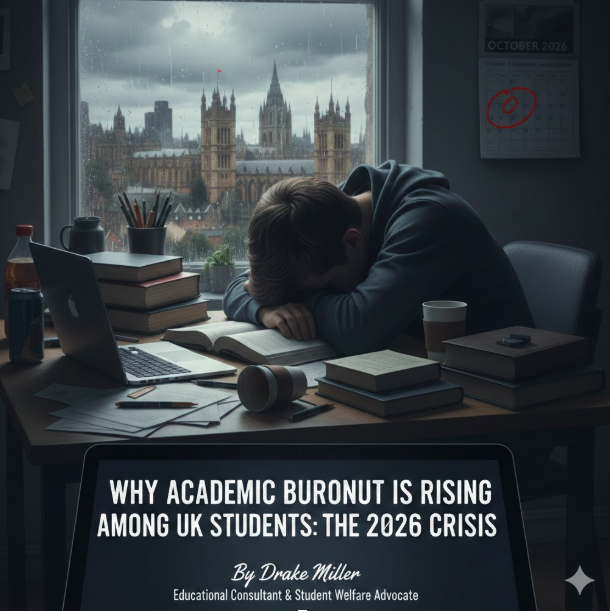
Educational Consultant & Student Welfare Advocate
In my fifteen years of working across UK secondary schools and universities, I have witnessed various shifts in student behavior. However, the landscape of 2026 is unlike anything we have seen before. What once manifested as simple “exam nerves” or “end-of-term fatigue” has evolved into a deep-seated structural crisis: Academic Burnout.
As students across England, Scotland, Wales, and Northern Ireland return to their desks this year, the pressure isn’t just about passing exams; it’s about surviving an era of unprecedented digital, economic, and social transition. For high schoolers aiming for Russell Group universities and undergraduates eyeing an increasingly volatile job market, the “mental load” has reached a breaking point.
The 2026 Data: A Growing Epidemic
According to the UK Student Mental Health Tracker 2026, over 88% of students reported feeling “emotionally exhausted” by the end of the first term. This is a significant jump from previous years. This isn’t just a lack of sleep; it’s a clinical state of burnout—a state where the mind simply refuses to engage with the material it is tasked to learn.
As someone who speaks with hundreds of students monthly, from GCSE candidates to PhD researchers, I’ve identified five key drivers making 2026 the most challenging year yet for the UK’s youth.
1. The “Human vs. AI” Efficiency Trap
In 2026, AI is no longer a “new” tool; it is integrated into every Virtual Learning Environment (VLE) in the UK. While these tools assist with research, they have inadvertently raised the “baseline” of expected output. Professors and examiners now expect a level of polish that was previously reserved for professional editors.
Students today feel they must compete with the speed and perfection of an algorithm. I often hear from A-Level students who suffer from “imposter syndrome” even when they do the work themselves. They fear their natural, human writing won’t look “polished” enough compared to the AI-enhanced submissions of their peers. This leads to Hyper-Revision—the act of studying double the hours just to validate one’s own human intelligence. This constant need to “prove” one’s humanity against a machine is a primary engine of modern exhaustion.
2. The Shift in UK Assessment Models: The “No-Break” Culture
The 2026 curriculum has seen a widespread push toward “Continuous High-Stakes Assessment.” This was originally intended to reduce the “all-or-nothing” pressure of traditional end-of-year final exams. However, the unintended consequence has been the creation of a “no-break” culture.
Students are now in a perpetual state of “deadline week.” From October through to June, there is no downtime. Every modular test, every bi-weekly essay, and every seminar presentation carries significant weight toward their final grade. This constant cortisol spike—the body’s stress hormone—is what leads to the massive “crash” we see in many students by early spring.
To cope with this relentless pace, many students are forced to find alternative ways to manage their workload. In my consulting work, I’ve seen a rise in students who seek external support to stay afloat. Whether it’s using a tutor to explain complex modules or seeking professional academic help to handle repetitive “busy work,” students are increasingly treating their education like a business that requires strategic outsourcing just to survive the modular grind.
3. The Legacy of the Cost-of-Living Crisis
While national headlines regarding inflation may have stabilized, the financial scars for the “Generation 2026” remain deep. For many university students, the maintenance loan barely covers the rent in academic hubs like Manchester, Bristol, or London.
The “starving student” trope is no longer a rite of passage; it is a mental health hazard. When a student spends 20 hours a week working in retail or gig-economy jobs just to afford basic groceries, and another 40 hours on a rigorous STEM or Law degree, burnout is no longer a possibility—it is an inevitability. In high-pressure technical courses, many students even begin searching for programming assignment help simply to keep up with complex coding projects and tight submission deadlines. This constant “survival mode” prevents the brain from entering the Default Mode Network—the neurological state of rest required for creativity and long-term memory consolidation. Without this “downtime,” the brain stays in a state of high-alert, leading to cognitive decline and irritability.
4. Social Comparison and “Productivity Dysmorphia”
Social media has evolved from a place of connection into a 24/7 stream of curated “study-grind” content. In 2026, the #DeepWork trend on platforms like TikTok and Instagram makes students feel that if they aren’t studying in a perfectly aesthetic, focused state for 10 hours a day, they are failing.
I call this Productivity Dysmorphia—a distorted view of how much work is actually healthy, possible, or effective. Students see “study-influencers” who seem to never sleep, always have color-coded notes, and maintain a 4.0 GPA. This creates a psychological gap between their reality (which includes fatigue and distraction) and the “ideal” digital student, leading to a sense of perpetual inadequacy.
5. The Erosion of “Third Spaces” for Students
A less discussed cause of burnout in 2026 is the disappearance of “third spaces”—low-cost areas where students can socialize without the pressure of studying or spending money. With many university common rooms being converted into extra lecture space and local youth centers closing, students are increasingly confined to their bedrooms or the library. When your place of rest (the bedroom) becomes your place of work, the brain never truly “switches off,” further blurring the lines between academic life and personal recovery.
See also: How Schools Can Reduce Staff Overload Without Adding More People
How to Spot the Burnout “Red Zones”
In my workshops, I teach students to identify these three “Red Zones” before they lead to a complete academic collapse.
| Zone | Physical Symptoms | Mental/Emotional Signals |
| Zone 1: The Warning | Disturbed sleep patterns; frequent tension headaches; “brain fog.” | Increased irritability; feeling “behind” regardless of progress. |
| Zone 2: The Resistance | Chronic fatigue; relying on excessive caffeine or stimulants to function. | Procrastination fueled by fear; loss of interest in hobbies or social life. |
| Zone 3: The Burnout | Weakened immune system (frequent colds/flu); digestive issues. | Complete cynicism; feeling that “none of this matters”; total emotional detachment. |
Drake’s Advice: Reclaiming Your Academic Life in 2026
If you are a student in the UK feeling the weight of the world, remember: Performance is a byproduct of health, not a replacement for it. Here are four non-negotiable strategies to implement:
- Audit Your Digital Intake: If #StudyTok or LinkedIn makes you feel guilty rather than inspired, mute the notifications. Your brain needs to see rest modeled as much as work.
- The 50/10 Rule: The human brain cannot maintain high-level focus for hours on end. Never work for more than 50 minutes without a 10-minute “no-screen” break. Walk, stretch, or simply stare out of a window to allow your optical nerves to relax.
- Strategic Outsourcing: Learn to distinguish between “deep learning tasks” and “administrative busy work.” If a specific assignment is standing in the way of your mental health, seek help. Whether it’s a peer study group, a university counselor, or professional guidance to help with my assignment, you do not have to carry the entire load alone.
- The “Zero-Day” Policy: At least one day a week must be a “Zero-Study Day.” No emails, no VLE logins, no textbooks. This allows the nervous system to regulate and prevents the “constant alert” state that leads to Zone 3 burnout.
Conclusion
The rise of academic burnout in the UK is a loud signal that our educational system is out of sync with human limits. However, while we wait for systemic change, the power lies in your boundaries. By recognizing the pressures of 2026 and choosing to prioritize your neurological health over aesthetic productivity, you can navigate your degree without sacrificing your well-being.
Frequently Asked Questions
Q.1 How do I know if I’m just stressed or actually burnt out?
Stress is usually tied to a specific deadline or event; once the exam is over, the stress fades. Burnout is a state of chronic physical and emotional exhaustion that persists even when you have no immediate work. If you feel “blank” or cynical about your entire degree rather than just worried about one test, you are likely in the Burnout Red Zone.
Q.2 Is it ethical to seek professional help for my assignments?
Yes, provided it is used as a learning aid. In the high-pressure environment of 2026, “strategic outsourcing” is a survival skill. Seeking expert assignment help can provide you with a high-quality roadmap or draft that helps you understand complex modular requirements, allowing you to focus your limited energy on deep learning rather than administrative “busy work.”
Q.3 Can academic burnout affect my physical health?
Absolutely. Prolonged cortisol (stress hormone) levels can weaken your immune system, leading to frequent colds, tension headaches, and gastrointestinal issues. In my work with UK students, I often see “Physical Collapse” follow “Mental Exhaustion” if the warning signs are ignored.
Q.4 What should I do if I’ve already hit “Zone 3” burnout?
First, communicate. Reach out to your university’s student welfare office or your personal tutor. Most UK institutions in 2026 have “extenuating circumstances” policies for mental health. Second, take a total digital detox for at least 48 hours. You cannot heal in the same environment that made you sick.
About the Author: Drake Miller
Drake Miller is a veteran UK educational consultant and writer specializing in student mental health and academic performance. With over a decade of experience advising schools on welfare policy, Drake’s work focuses on balancing high-achievement culture with sustainable living. He is a frequent contributor to UK educational forums and a vocal advocate for reform in student financial support.